
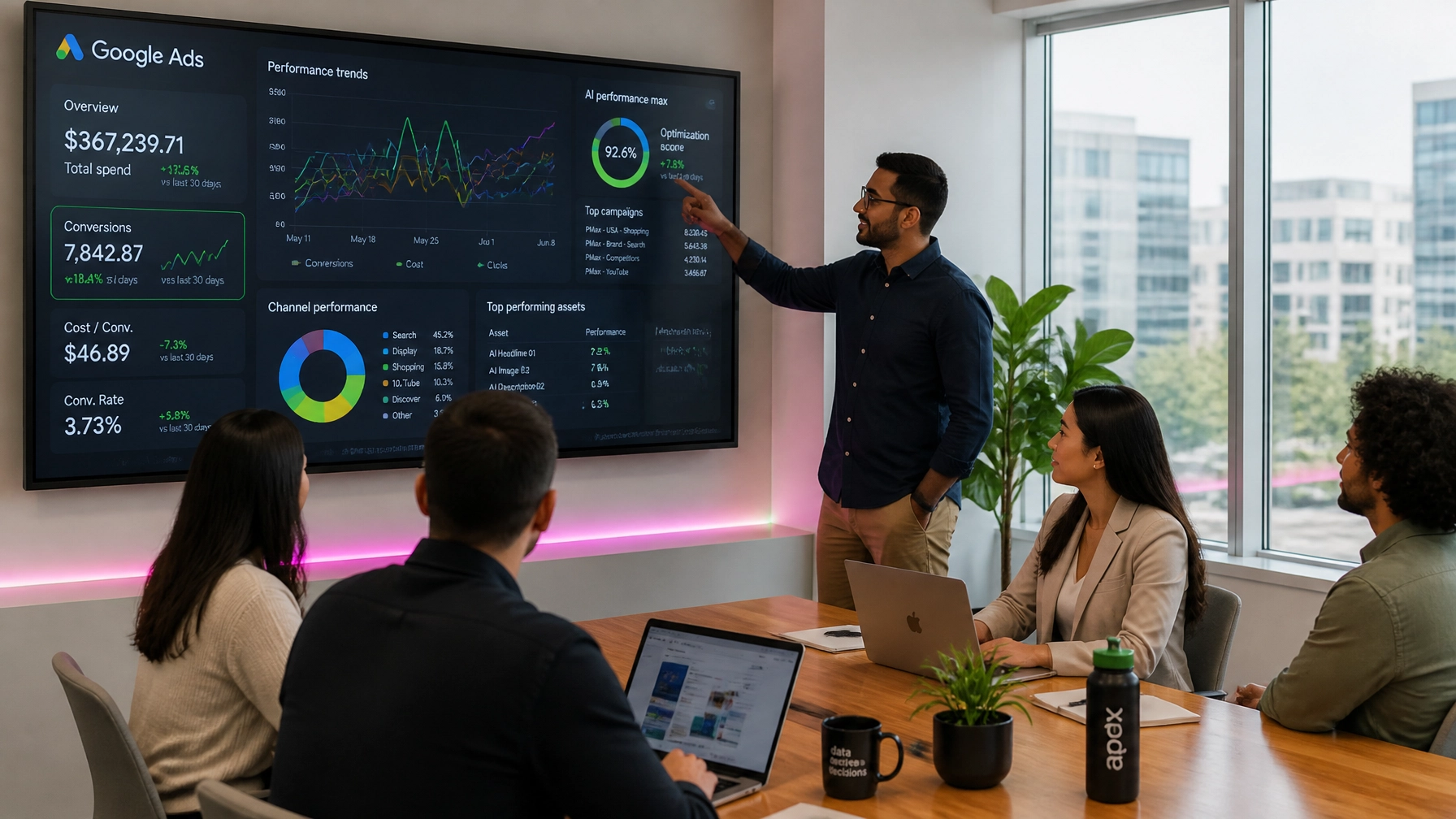
In the digital age, a high-performing search strategy is no longer a luxury but a fundamental necessity for business survival. For small to mid-size enterprises, the landscape of google ads management has undergone a seismic shift, transitioning from simple keyword matching to complex, AI-driven orchestration. Marketing has always been a battle for attention, but in 2026, it is a battle of data precision and strategic automation.
Many organizations continue to operate with legacy frameworks that are not only inefficient but actively detrimental to their return on investment (ROI). To compete in an environment where speed and intelligence are the primary currencies, businesses must evolve. Failure to adapt to modern mandates: such as Agentic AI and unified data streams: will result in wasted capital and lost market share.
Here are the seven critical mistakes currently undermining your Google Ads performance and the strategic mandates required to correct them.
1. Operating Without Deep Data Integration
The most significant error in modern google ads management is treating ad platforms as isolated silos. In 2026, "conversion" is a multi-dimensional metric. If your tracking is limited to simple form-fills or clicks, your bidding algorithms are essentially flying blind.
High-stakes competition requires the integration of offline conversion data. This is particularly relevant for businesses utilizing a 24/7 inbound call center. Currently, 88% of contact centers utilize AI to process and categorize interactions. By feeding AI-scored call outcomes: such as "high-intent lead" or "qualified purchaser": directly back into Google Ads, you allow the algorithm to optimize for revenue rather than mere volume. Ignoring this data loop means you are bidding for traffic that may never convert into a tangible sale.
2. Relinquishing Total Control to Automation
There is a dangerous trend of "blind reliance" on Google’s automated tools, such as Performance Max (PMax) and Broad Match. While these tools are powerful, running them without rigorous guardrails is a strategic failure.
Automation requires supervision. Without negative keyword exclusions and audience signals, AI can drift into irrelevant queries that drain your budget. A professional digital marketing agency for startups understands that the goal is not to fight the AI, but to guide it. You must provide the machine with the highest quality inputs: first-party data and clear objective parameters: to ensure the resulting output aligns with your bottom line.

3. Neglecting the Power of Agentic AI for Lead Response
Marketing does not end at the click; it ends at the resolution. A common mistake is investing heavily in driving traffic but failing to manage the subsequent influx of inquiries. This is where Agentic AI: autonomous agents capable of multi-step task execution: has become necessary.
Research indicates that agentic AI can now autonomously resolve 70–85% of routine calls and inquiries. From a cost perspective, the transition is staggering: AI-driven resolutions cost between $1 and $3 per interaction, compared to the $13.50+ required for traditional human-only handling. By failing to integrate these agents into your lead management workflow, you create a bottleneck that diminishes the value of every dollar spent on Google Ads.
4. Clinging to Legacy Account Structures
The era of Single Keyword Ad Groups (SKAGs) and hyper-segmented account structures is over. In 2026, Google’s machine learning performs best when it has a consolidated pool of data to analyze.
Maintaining a fragmented account structure prevents the algorithm from achieving the "learning density" required to optimize effectively. Transitioning to intent-based structures: where campaigns are organized by business objective rather than granular keyword variations: is essential for scaling. If your account looks the same as it did in 2022, you are likely suffering from high CPA (Cost Per Acquisition) due to inefficient data distribution.
5. Utilizing Static and Uninspired Creative Assets
Google Ads is increasingly becoming a visual and multi-modal platform. A frequent error among SMBs is the use of generic, text-heavy ads that fail to capture the user’s attention.
Creative performance is now a primary driver of ad rank and engagement. Utilizing professional creative design services for high-resolution graphics and video assets is no longer optional. Your ads must be as polished and professional as your website to build immediate trust. In an age of visual search and AI-generated overviews, static and outdated creative assets are a direct path to invisibility.
6. Overlooking Search Intelligence and Negative Keywords
While broad match is the new standard, it requires a robust defense. Many managers fail to audit their "Search Term Reports" frequently enough to identify waste.
Mistakenly blocking high-intent queries with outdated negative lists: or failing to add new exclusions as search trends evolve: leads to significant budget leakage. Effective management involves a constant feedback loop between your customer service data and your ad account. For instance, if your live chat support identifies a recurring trend of unqualified inquiries, those insights should be immediately translated into negative keywords for your campaigns.
7. Ignoring the Synergy Between SEO and Paid Search
A common strategic oversight is treating Google Ads and SEO as separate entities. In reality, they are two sides of the same coin.
If your paid ads are successful, they provide valuable data on high-converting keywords that should inform your long-term SEO strategy. Conversely, a strong organic presence improves your Quality Score, which can lower your CPC (Cost Per Click). Viewing these channels in isolation is a missed opportunity for holistic growth. A comprehensive approach ensures that your brand dominates both the paid and organic sections of the search results page
Conclusion: The Path to Strategic Excellence
The transition from traditional advertising to AI-integrated marketing is exciting but also overwhelming. However, the data is clear: the businesses that thrive in 2026 will be those that embrace technical precision and unified service models.
At B2B IT Solutions, we specialize in bridge-building; connecting your digital marketing efforts with world-class call center support and custom tech. By eliminating these seven common mistakes, you can transform your Google Ads account from a cost center into a powerful engine for predictable growth.
The necessity of professional management cannot be overstated. In a landscape defined by agentic AI and rapid technological evolution, standing still is the most expensive mistake of all.