
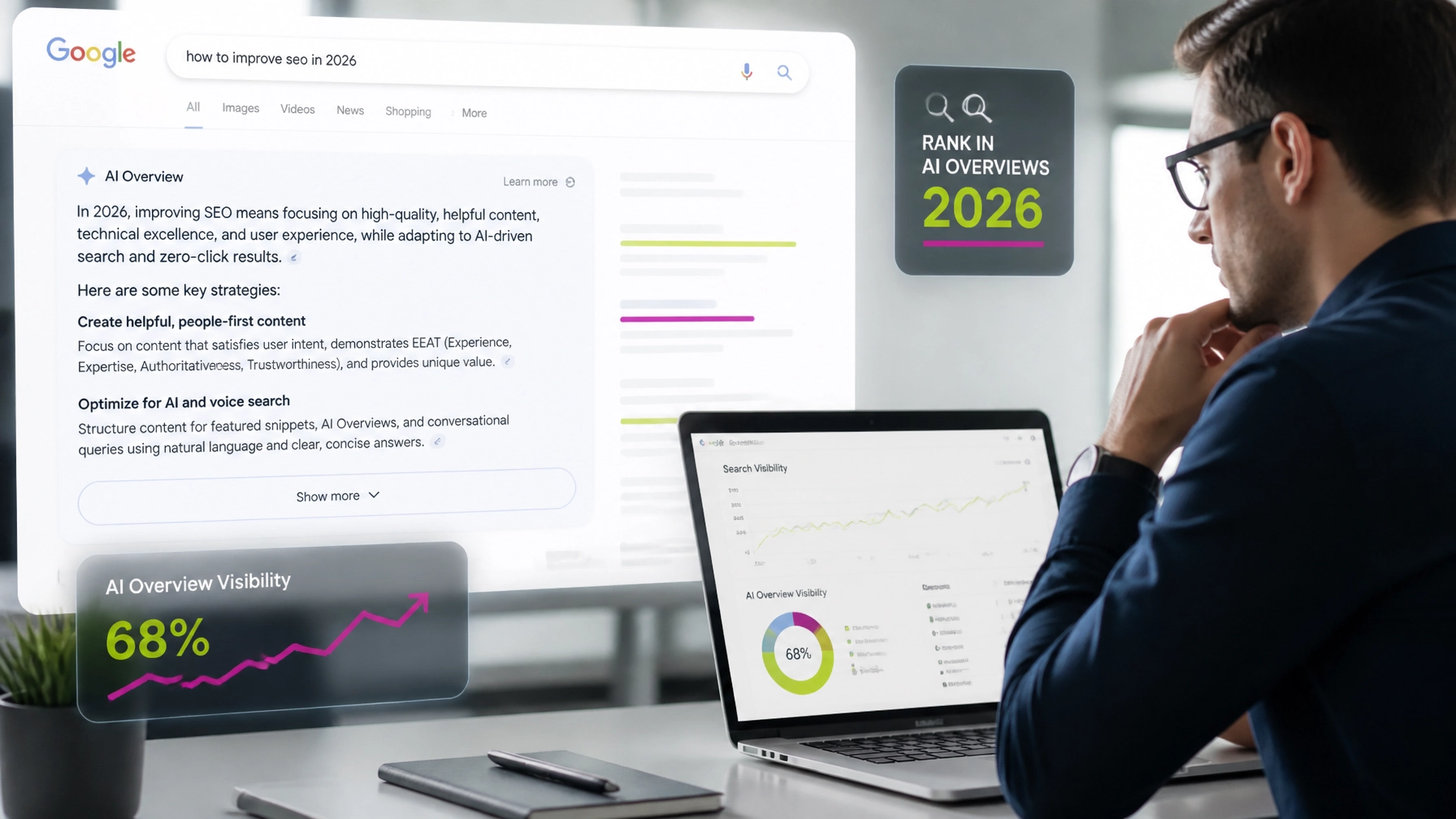
Google AI Overviews have become a major search surface in 2026. They appear across a growing share of informational and commercial queries, changing how users discover businesses online. Ranking now means more than reaching the first page of blue links; it means creating content that Google can understand, trust, summarise, and cite in its AI-generated answer.
For small businesses and startups, this shift is exciting but also overwhelming. Established competitors may have larger budgets, more backlinks, and years of accumulated visibility. However, AI Overviews create a more focused opportunity: a business with clear niche expertise, strong local relevance, and genuinely useful answers can become the source Google selects.
What does ranking in Google AI Overviews actually mean?
Ranking in Google AI Overviews means earning visibility as a cited source inside Google’s generated answer, while also maintaining strong traditional organic rankings. The two goals support each other, but they are not identical.
Traditional SEO focuses on ranking a page for a target keyword. AI search adds another requirement: the page must contain clear, credible, self-contained information that can be extracted and used to answer a specific question.
This means businesses must optimise for:
- Visibility in standard organic search results
- Clear answers to real customer questions
- Strong topical and local authority
- Reliable technical performance
- Trust signals that confirm the business is legitimate and knowledgeable
The strategic objective is no longer simply to publish more content. It is to become the most useful and verifiable answer within a defined subject area.
How does answer-first content increase AI Overview visibility?
Answer-first content places the direct answer before the background explanation. The first 40–60 words beneath the main heading should give readers and search systems a concise response to the page’s primary question.
For example, a page targeting “SEO services for small businesses" should not begin with a long history of search marketing. It should immediately explain what the service does and why it matters.
SEO services for small business improve online visibility by targeting relevant search terms, strengthening website quality, publishing useful content, and building trust with search engines and customers. A consistent SEO strategy helps smaller companies attract qualified organic traffic without depending entirely on paid advertising.
This structure creates an answer that is easy to understand, quote, and expand upon. Supporting paragraphs can then explain the process, benefits, examples, and implementation details.
Every important section should follow the same principle:
- State the answer.
- Explain why it matters.
- Provide practical steps.
- Add evidence, examples, or business context.
This approach improves user experience as well as AI extraction. Readers receive value immediately, while search systems can identify the page’s key point without interpreting several paragraphs of introductory material.

Why should headings match real customer questions?
Question-matched headings help Google connect a page with conversational searches. Users increasingly search in complete sentences, particularly when using voice search or AI-assisted search interfaces.
Headings should therefore reflect the language customers actually use. Instead of writing a vague heading such as “Content Strategy,” a business could use:
- What content helps a small business appear in AI Overviews?
- How long does SEO take for a startup?
- Why is local SEO important for service businesses?
- What should a business include on its Google Ads landing page?
- How can website speed affect organic traffic?
Each H2 or H3 should answer one clearly defined question. The opening sentence beneath the heading should provide the direct answer, followed by supporting detail.
This method also creates a natural content framework. When each heading represents a meaningful customer concern, the article becomes more comprehensive without becoming unfocused.
Can schema markup help a page appear in AI Overviews?
Schema markup helps search engines interpret the meaning, purpose, and structure of a page. It does not guarantee an AI Overview citation, but it removes unnecessary ambiguity and supports more accurate understanding.
Small businesses should consider the following schema types where they accurately represent the page:
- FAQ schema for genuine question-and-answer sections
- HowTo schema for step-by-step processes
- Organization schema for company identity and business information
- Service schema for clearly defined services
- Article schema for guides, insights, and educational content
Schema must reflect visible page content. Adding irrelevant or misleading markup can reduce trust rather than improve visibility. The strongest implementation combines accurate schema with useful writing, logical internal linking, clear business information, and a technically accessible website.
A professional SEO team can audit existing pages, identify suitable schema opportunities, and apply structured data consistently across service pages, location pages, and educational content.
Why do original data and clear sourcing matter?
AI systems prefer information that is specific, verifiable, and difficult to confuse with generic marketing language. A page that repeats broad statements such as “SEO increases visibility” provides limited evidence of expertise.
Original information creates stronger citation potential. Examples include:
- Anonymised performance trends from completed campaigns
- Industry-specific conversion benchmarks
- A breakdown of common customer questions
- A documented website improvement process
- Original survey findings
- Local pricing ranges explained with appropriate context
- Before-and-after technical performance observations
Businesses should also explain how information was obtained. Clear sourcing does not require excessive academic language. It means distinguishing between internal observations, client results, industry knowledge, and general recommendations.
Specificity is an important competitive advantage. A detailed answer for a narrow industry often provides more value than a generic guide written for everyone.
How do NAP consistency and local signals influence AI selection?
'NAP' means Name, Address, and Phone number. These details should remain consistent across the business website, local listings, social profiles, directories, and other legitimate business references.
Inconsistent information can make it harder for search systems to connect different mentions to the same business entity. Local businesses should maintain:
- A consistent business name
- The same address format wherever an address is displayed
- A reliable phone number
- Accurate opening hours
- Clearly defined service areas
- Relevant business categories
- Genuine customer reviews and responses
- Location-specific service pages where appropriate
Local relevance is particularly valuable for small businesses. A specialist provider that clearly serves a particular city, industry, or customer group can be more relevant to an AI-generated answer than a large company with broad but shallow coverage.
Why are content clusters more powerful than one-off blog posts?
One isolated article rarely establishes authority. A content cluster connects a central pillar page with supporting articles that answer related questions in greater detail.
For example, a small business targeting SEO could build a cluster around:
- A central guide to SEO services for small business
- Local SEO for service providers
- Keyword research for startups
- Technical SEO essentials
- SEO content writing
- SEO and Google Ads
- Website speed and organic traffic
- Measuring organic lead generation
Each supporting article should link naturally to the main guide and to relevant service pages. This demonstrates depth, improves navigation, and helps search engines understand the company’s expertise.
The same principle applies to a startup seeking a digital marketing agency for startups. A strong agency should be able to demonstrate knowledge across SEO, content marketing, social media, email marketing, branding, and paid acquisition rather than publishing disconnected promotional posts.
Why is mobile-first performance necessary in 2026?
A page cannot perform well in AI search if users struggle to load or use it. Mobile-first performance is now a basic requirement for both search visibility and conversion.
Businesses should prioritise the following:
- Fast loading of the main page content
- Compressed images in modern formats
- Minimal unnecessary scripts
- Responsive layouts across screen sizes
- Stable page elements that do not shift while loading
- Easy-to-use menus, forms, and buttons
- Strong interaction performance
- Secure, crawlable, indexable pages
Core Web Vitals provide a practical framework for evaluating loading speed, responsiveness, and visual stability. These metrics should be reviewed across important landing pages, not only the homepage.
For businesses with slow, outdated, or difficult-to-manage websites, Custom Web Development Solutions can provide a stronger foundation. A custom website can be structured around search visibility, user experience, scalability, conversion paths, and ongoing support from the beginning.
How do brand mentions and citations build trust?
Google does not evaluate a business only through its own website. Consistent brand mentions across credible online environments help reinforce business identity and authority.
Businesses should aim to earn legitimate mentions through:
- Industry partnerships
- Local business profiles
- Supplier and association pages
- Digital PR
- Expert commentary
- Customer case studies
- Original research
- Community involvement
- Professional directory listings
The objective is not to collect random links. It is to build a consistent reputation around the business, its services, location, and expertise.
A strong brand presence also supports paid and organic marketing. Customers who encounter a business through search, social media, recommendations, or advertising are more likely to trust it when the same identity and value proposition appear consistently.
Why do small businesses have an advantage in AI search?
Small businesses can compete effectively because AI search rewards relevance, clarity, and expertise rather than size alone. A specialist company can answer narrow questions with greater practical detail than a large generic competitor.
A local business may understand:
- The needs of a specific customer group
- The terminology used in a particular industry
- Regional buying behaviour
- Common operational challenges
- Local regulations or service expectations
- The questions customers ask before making contact
That knowledge should be converted into structured pages, detailed FAQs, case studies, service explanations, and useful guides. Niche expertise becomes a search asset when it is visible, organised, and supported by credible business signals.
How can professional SEO services implement this systematically?
Professional SEO services for small businesses turn these principles into a repeatable growth system. The process should begin with technical and content audits, followed by keyword and customer-question research.
A systematic programme typically includes:
- Identifying commercial and informational search opportunities.
- Mapping customer questions to existing and planned pages.
- Rebuilding priority pages with answer-first structures.
- Developing content clusters around core services.
- Improving internal links and calls to action.
- Applying appropriate schema markup.
- Strengthening local business information and NAP consistency.
- Monitoring rankings, impressions, engagement, and qualified enquiries.
- Refreshing content as customer needs and search behaviour change.
SEO should work alongside other acquisition channels. Google Ads management can generate immediate visibility for high-value searches while organic content develops authority over time. This combination gives small businesses both short-term reach and long-term traffic potential.
What should a small business do first?
The first step is to select three to five valuable customer questions connected to the company’s most profitable services. Each question should receive a direct answer, a useful explanation, and a clear next action.
The second step is to improve the technical foundation of the website. The third is to create a connected content cluster that demonstrates genuine expertise.
Google AI Overviews have changed the definition of search success. Businesses that continue to publish generic pages and measure only blue-link rankings will miss a growing source of visibility. Businesses that provide direct answers, demonstrate authority, maintain technical quality, and communicate their specialist value will be better positioned to become the sources AI search selects.
In 2026, optimisation for AI Overviews is no longer optional. It is a necessary part of a sustainable organic growth strategy.